


Browse. Linger. Treat yourself to Something Special.
Something like a set of cups and saucers to enjoy your new Graffeo beans.
Right: Raffaellesco pattern, Deruta majolica
At Biordi, you can shop collections by artisan or region from where they're produced.
BIORDI ART IMPORTS
Voted Best of the Bay, 2021, 2022, 2023, 2024, 2025 for Best Overall Store
412 Columbus Ave. / www.biordi.com
~ Everyday Moments, Made Extraordinary ~
After picking up your coffee beans at Graffeo's Roastery, stroll down three blocks on Columbus, cross the street, and slip into an exquisite boutique where a grand collection of artisan ceramics awaits. From home decor and kitchenware to Florentine gift wrap paper, vintage posters, (and even Graffeo coffee beans), you'll stand awestruck, wondering if you're still in San Francisco or have somehow been magically transported to Italia.
Biordi Art Imports opened in 1946 when Abruzzese immigrant, Emilio Biordi, had the goal of filling a shop with a broad range of artisan goods. He called it Biordi Artigianato Italiano and focused on products such as espresso machines, ravioli cutters, rolling pins, and pasta machines. Ceramics were relegated to the store's corners. In time, it was the ceramics that drew attention from far and wide—among fans was Chuck Williams of Williams-Sonoma.
In 1977, Emilio sold the business to Florentine native, Gianfranco Savio, who had fallen in love with the store. Finding Gianfranco a kindred spirit, Emilio went on to mentor him for a year. Gianfranco spent the next 42 years traveling throughout Italy, building relationships with artisan families—making Biordi Art Imports a most preeminent and trusted retailer of high-quality Italian majolica. In 2018, he sold the store to Michael and Deborah Baldini, who continue the Biordi legacy.

What is Majolica?
No doubt, you've seen it, but may not exactly know what it is. Here's
the Inside Scoop: Majolica is earthenware that is fired, dipped in an opaque white tin glaze, painted with bright mineral pigments, and fired again to fuse the colors into the glaze. The result is the glossy, richly colored ceramic associated with Renaissance Italy and, later, Victorian England.

Grateful to Biordi Art Imports
for these fascinating photos.
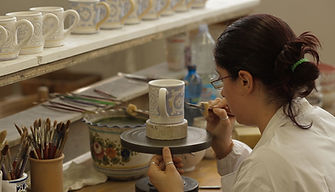

Tin glazing developed in the Islamic world around the 9th century, partly as an attempt to imitate Chinese porcelain. The technique traveled through Moorish Spain, where lusterware from Málaga and Valencia was shipped to Italy via the island of Majorca.


Italian potters perfected the style in the 15th and 16th centuries. Towns like Faenza, Deruta, Urbino, and Gubbio became famous for istoriato ware: plates and vessels painted with detailed narrative scenes from mythology and the Bible. Faenza was so influential that its name gave rise to the French term "faïence," and the tradition spread to France and beyond. In the 19th century, English artisans revived and adapted the craft with lead glazes.
Do you wonder which platter Joanna Instaschi
used when entertaining Petra and John in Petra's Quest?


